
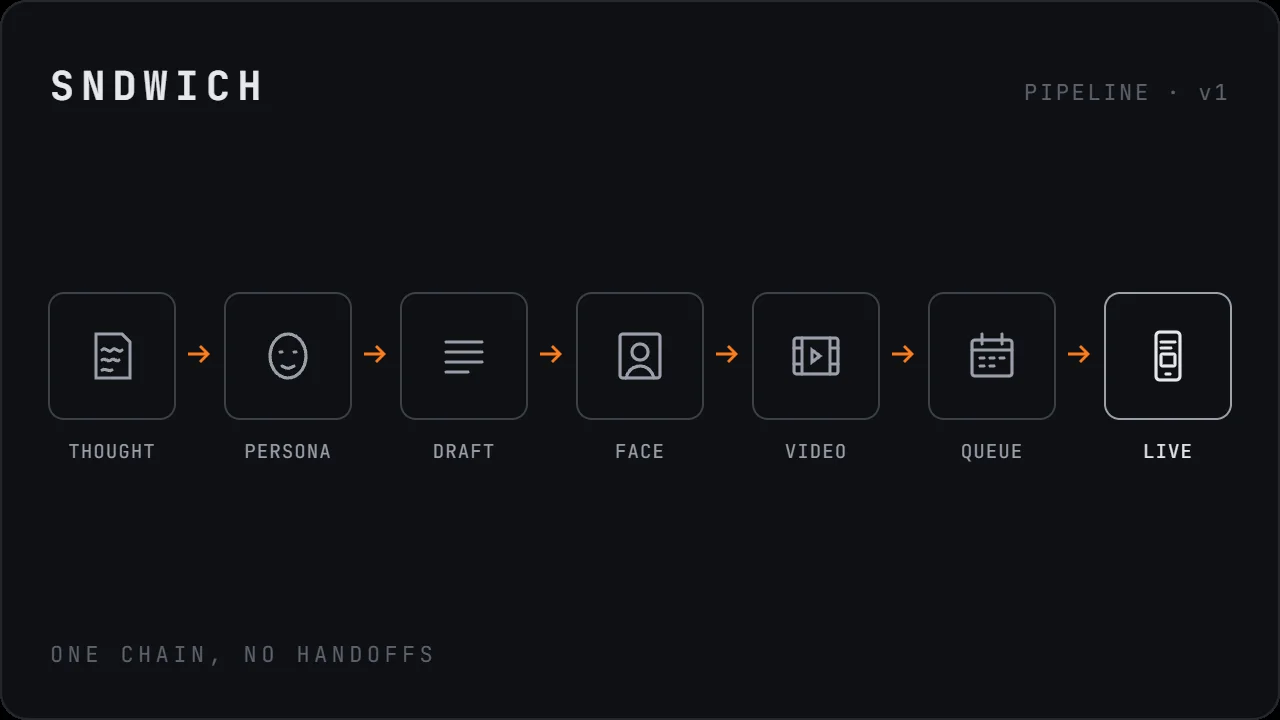
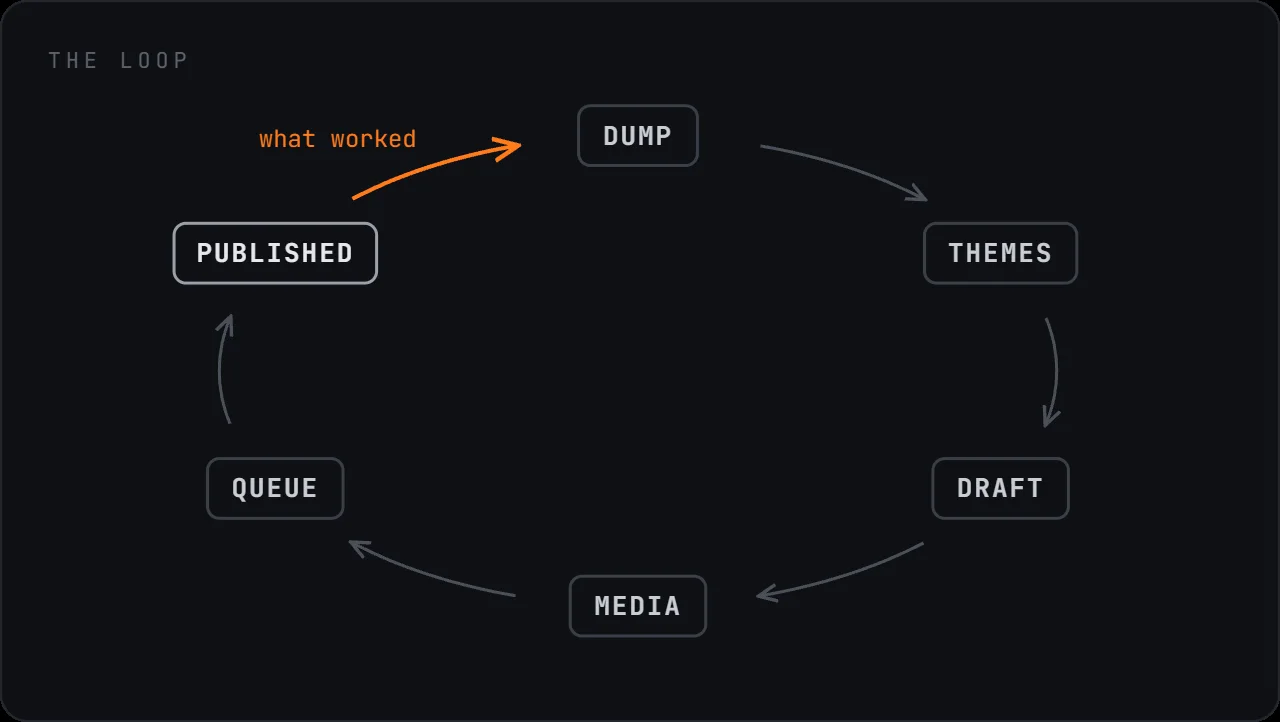
This is not "AI writes your tweets." This is a closed loop from a half-finished thought to a published video with your face in it — the expensive middle of content where most people quit and go back to doing it by hand.
The idea behind an AI that posts as you
You supply judgement. The persona supplies identity. The pipeline supplies everything between a thought and a published post.
Most AI content tools optimise for the demo: one prompt, one clever paragraph, one screenshot for Twitter. Accounts do not grow on clever paragraphs. They grow on consistency in a recognisable voice, which means the hard part was never generation — it was the five handoffs between tools where the voice drifts.
1. The persona is evidence, not adjectives
Everyone starts by describing themselves to the model. "Write in a casual, witty, direct voice." It does not work, and the reason took me months to accept: a model copies examples far harder than it obeys instructions.
So a persona here is a file of evidence:
| Field | What it is | Floor |
|---|---|---|
| posts | things you actually wrote | 5 |
| anti-examples | "I don't write like this" | optional, strongest signal |
| face | reference photos, consented | 3–8 |
| voice | a speech sample, cloned | 15–90s |
| accounts | where it publishes | 1+ |
The anti-examples are the part nobody builds. Counter-examples steer a voice harder than more positive samples do — telling a model what you are not narrows it faster than ten more things you are.
And the face is not only photos you own. If the persona is fictional, the system generates a face that belongs to nobody. If you have one good shot, it derives the other angles from it, so a persona with a single photo still gets a usable reference set. We take the face and voice side apart in a separate piece on giving a persona a face and a cloned voice.
nano-banana-2        invent a face from nothing
nano-banana-2/edit   derive angles from the photos you have
2. Thoughts in, structure out
The hard part of posting consistently is not writing. It is having something worth saying on a Tuesday.
So there is a box you dump into. Half-thoughts, a thing a customer said, bullet points with no verbs, a screenshot caption from three weeks ago. Up to 4000 characters of mess. It comes back sorted into themes against your own content pillars — not a schedule, not finished posts, but a bank of things worth saying, which is the thing that actually runs out.
Weak dump:
ideas for next week
ai stuff
maybe something about the new model
Strong dump:
customer said our onboarding "felt like homework" — that's a good line
the scan cost dropped 50% after one word change, latest → top
i was wrong about why the buttons weren't clickable, twice
seedance rejects photorealistic faces, any of them, rasterizing doesn't help
someone asked how many personas is too many. i don't know. find out.
Same box. The second one produces a month of posts because every line is a specific with a reason to exist.
3. Writing, with the guards on
This is where tools quietly fail you, and the failures are specific enough to name. All three below are measured, on real output, not hypotheticals.
It invents facts about your business
I gave it a 179-character draft that said only "three tools and a spreadsheet." It came back naming Notion and Buffer, pricing a commute at "forty minutes," and turning a Monday review into "six minutes instead of twenty-something." None of that was in the draft. All of it would have published as fact about my company.
The writer is now forbidden from inventing a number, a tool name, a date or a statistic. Where a specific would make the post land, it leaves a bracket:
# Facts (non-negotiable)
NEVER INVENT FACTS. Only the facts, numbers, names, products, dates and
durations already present in the material you were given may appear as
fact. Naming a tool the user did not name, putting a number on something
they left unmeasured, dating something they left undated, or reporting as
done something they raised as a possibility are all inventions, however
plausible they sound and however much better they make the post read.
This includes statistics: no "80% of teams", no "most people", unless the
figure was given to you.

Developing the idea is the job — argue it, give it a shape, take it
somewhere. Sharpening a vague phrase into a precise one is not: where a
missing specific would make the post land, write a [square-bracket
placeholder] for the user to fill in rather than making one up.
That last paragraph is the hard part. A blanket "use only what you were given" makes it unable to expand a one-line hook into a post at all. The rule has to forbid manufactured specifics without forbidding the writing.
Everything comes out sounding the same
I asked for seven posts. Five opened by admitting a mistake. Not one asked a question — although a genuine question is first on the list of moves the prompt offers. That is not randomness. A batch can vary against itself because it sees all its posts at once. A single post has nothing to vary against, so the model reaches for whichever move fits best — correct once, a monoculture seven times.
Fix: the server names the move, seeded on the draft and the style, so one idea written two ways moves two ways. Deterministic, so a regenerate of the same draft does not silently change it and make two runs impossible to compare.
A quoted example becomes the thing it produces
The loud style once carried this in its instruction:
make it a verdict ("X is done."), a danger call ("this is getting
dangerous:") or an exclusivity line ("nobody is pricing this in:")
Every loud post began with "this is getting dangerous:". The quotes were meant as illustrations. The model read them as the deliverable. Those three phrases are now on a ban list, and the instruction describes shapes instead:
If you take one thing from this article, take that one. Never put an example phrase inside an instruction unless you want it back verbatim.
4. The face: a swap that keeps the person
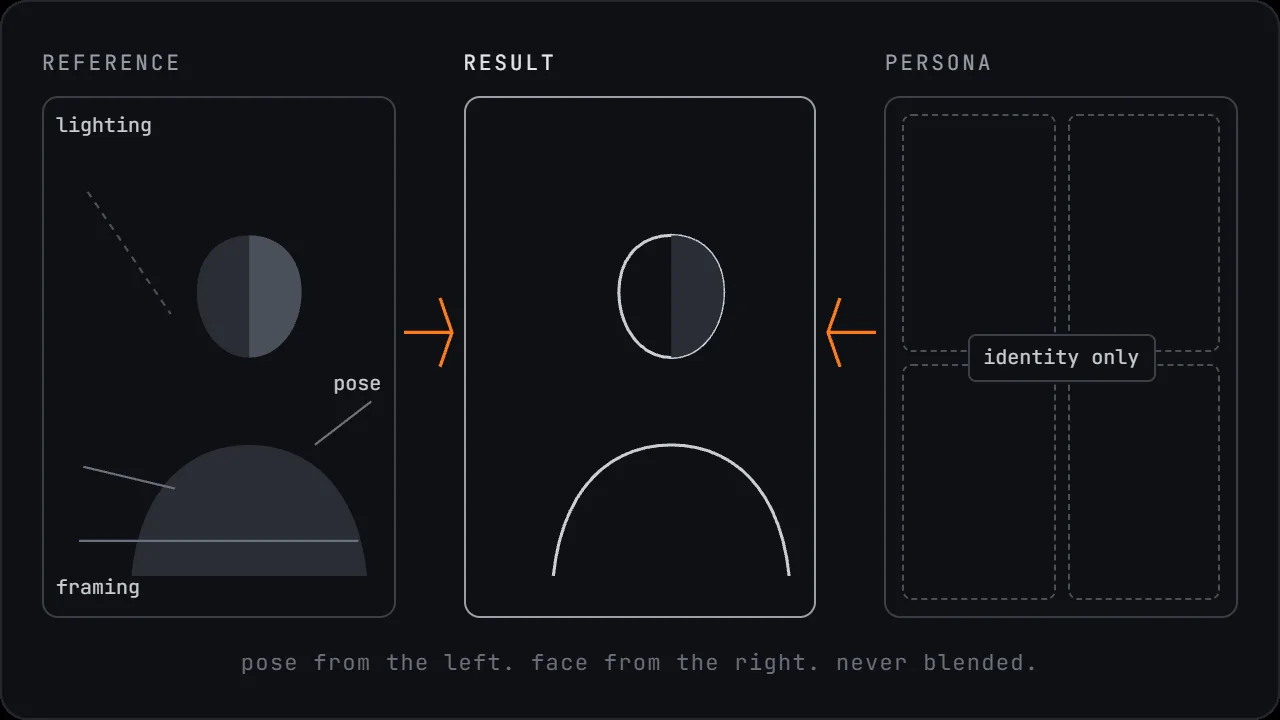
Upload a reference frame — a pose, a lighting setup, a shot you like. The persona's face goes into it. The measured lever here is not the model. It is the order of the images and the division of labour in the prompt. This is the real one, running in production:
image_urls: [frameUrl, ...personaPhotos.slice(0, 3)]

"Create a photorealistic portrait of the PERSON FROM THE SECOND AND LATER
 reference images, posed and lit exactly like the FIRST reference image.

 Identity, facial structure, features and skin tone come ONLY from the
 later references; they must be instantly recognisable as the same person,
 do not blend faces.

 Head angle, camera distance, framing, lighting direction, softness,
 shadows, colour temperature and overall mood come ONLY from the first
 image.

 Sharp focus on the face, natural skin texture, no glasses or hat unless
 the first image has them."
Three things in there earn their place:
For video there is a separate job on Wan 2.2 animate/replace, which replaces a performer across a clip rather than a single frame.
5. The video catalogue
Seventeen job types, each a named model rather than one generic "generate video" button. The ones that matter:
| Job | Model | What it does |
|---|---|---|
| ai.t2v | Seedance 2.5 | text → video |
| ai.animate | Seedance 2.5 | image → video |
| ai.ref2vid | Seedance 2.5 | references → video |
| ai.kling | Kling o3 pro | reference → video |
| ai.swap | Wan 2.2 animate/replace | face replacement in a clip |
| ai.talk | OmniHuman 1.5 | talking head from a photo |
| ai.lipsync | sync-lipsync v2 | match mouth to audio |
| ai.mocap | Kling 2.6 motion-control | drive a character with motion |
| ai.tts | MiniMax speech-02-hd | your cloned voice speaks |
| ai.dub | ElevenLabs dubbing | another language, same voice |
| ai.restore | SeedVR upscale | fix a low-res source |
| ai.fps | RIFE | frame interpolation |
Each one is a job, not a request you sit and watch. You start a render and walk away; it tells you when it lands.
We put four of these engines through the same five seconds in a head-to-head on one clip, with the prices our own invoice charges rather than anybody's pricing page.
6. One post, four networks, your clock
Telegram, X, Instagram, Threads. Same post retuned per platform rather than copy-pasted — X gets its character cap, Instagram gets hashtags at the end, Telegram gets none and room to breathe.
Scheduled on your clock. That sounds too obvious to mention. It was not: slot times were built with setHours, which reads the server's clock, and the server is UTC. A 9:00 post went out at 11:00 in Tallinn and drifted another hour twice a year. Every scheduling tool has this bug until someone reports it. Check yours against a named IANA zone:
// wrong — the server's clock
d.setHours(9, 0, 0, 0)

// right — a wall clock in a named zone
utcForWallClock({ year, month, day, hour: 9, minute: 0 }, "Europe/Tallinn")
What an AI that posts as you is good for (and not)
Good for:
It also does not replace taste in video. Generated b-roll is generated b-roll. It earns its keep on talking heads, stills, and edits of footage you shot — not on hero cinematics. And one prompt will not replace knowing your audience. A force multiplier will, if you already know what good looks like.
Brief it like an operator
Weak: "write me a post about our new feature". Strong:
hook: the scan cost dropped 50% after one word
what happened: we were reading X's "Latest" tab. twenty newest posts over
  a like floor. on a busy term that's a window a few hours wide, owned by
  whoever posts most often.
the number: a post with 747k views in my niche had never been collected.
  not once.
the fix: Latest → Top, plus a date window.
the result: median age of a collected post, 139 days → 6.
style: take
do not: invent any number i didn't give you
Same model. The difference is that the second brief contains facts the model cannot invent, so it does not have to.
What it costs
From the billing ledger, not a pricing page:
| Operation | Price |
|---|---|
| image, fast (FLUX schnell) | $0.003 |
| image, quality (gpt-image-1) | $0.04 |
| trend scan across 6 niches | $0.032 |
| X post read | $0.0002 |
The expensive part of AI content was never the tokens. It is the posts you publish and regret. We broke the per-second video numbers down separately in what a second of AI video actually costs, and the per-request LLM maths in what one AI call really costs.
Three findings worth stealing
If you are building anything in this space, take these — they cost me months each:
One chain, no handoffs
Sndwich runs this whole pipeline as one chain: a persona built from your evidence, a drafter with the guards on, a face that keeps the person, and scheduling on your own clock across four networks. No copy-paste between tools.
 5 minAll your social media in one place: post to Telegram, X and Instagram at once
 6 minWan 3 vs Seedance 2.5: four models, one clip, one winner
 6 minAI video API pricing: we paid twice for the same model and measured it